Reclaim. Reactivate. Contain
Low-Alkali Ionic Reactivation of Industrial Clays
reCLAYmed™ is ARC Innovations’ third-generation platform for restoring value to inert or degraded clay wastes.


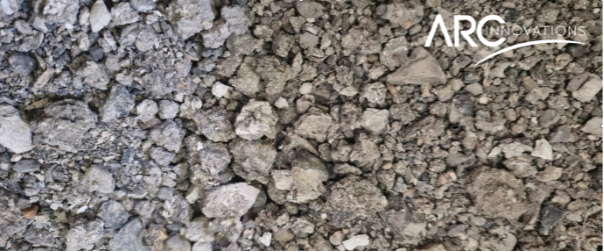
Instead of energy-intensive re-calcination, reCLAYmed™ applies a controlled, low-alkali Multi-Salt Catalyst™ (MSC™) treatment to reactivate clay surfaces, restore dissolution kinetics and reintroduce reactive aluminosilicate domains.
The result is a reclaimed clay aggregate capable of functioning as:
- A compacted clay liner (CCL) aggregate
- A chemo-hydraulic barrier material
- A supplementary cementitious component (where formulation permits)
The Scientific Basis
High-temperature calcination consumes energy and carbon. reCLAYmed™ achieves reactivation chemically rather than thermally.
The MSC™ regime:
- Promotes surface complexation reactions
- Enhances ionic-strength-driven dissolution flux
- Generates controlled lattice defects
- Increases accessible amorphous aluminosilicate content
- Restores reactive surface sites
In specific mineralogical contexts, tailored salt environments assist in stabilising reactive domains against rapid recrystallisation.The outcome is renewed pozzolanic potential and liner functionality without the embodied energy penalty of secondary firing.
Adaptive Processing Framework
Feedstocks vary widely in:
- Mineralogy
- Contamination history
- Thermal exposure
- Degree of structural degradation
The MSC™ dosing protocol is therefore adaptive. In-process controls include:
- pH
- Conductivity
- Rheology / viscosity
This ensures reactivation is aligned with the specific characteristics of the waste stream.
Liner Performance Validation
Testing against compacted clay liner acceptance criteria demonstrates that selected MSC™ variants can achieve hydraulic conductivity and containment performance approaching those of conventional bentonite-amended systems.
Earlier generations established the principle:
- Generation 1: Catalytic activation of mineral wastes into functional chemical barriers
- Generation 2: Field deployment of chemo-hydraulic liners
- Generation 3 (reCLAYmed™): Reactivation of inert clays with restored pozzolanic participation and improved energy efficiency
The platform substantially reduces embodied energy while maintaining containment integrity.
Commercial and Strategic Advantage
reCLAYmed™ addresses three structural constraints:
- Bentonite scarcity
- High transport costs
- Carbon reduction mandates
By converting on-site clay waste into engineered liner material, the system reduces import dependency while maintaining regulatory performance standards.
Deployment Pathway
Implementation follows a disciplined sequence:
- Feedstock audit and mineralogical screening
- MSC™ tuning with rapid reactivity proxies
- Bench-scale permeability and strength validation
- Pilot compacted liner trial
- Full-scale deployment aligned with containment specifications
The outcome is both environmental mitigation and operational cost control.
Interested in our cutting-edge solutions?
Connect with us to explore how our solutions can elevate your next project.