
Ash to Aggregate
Converting Legacy Ash into Engineered Construction Material
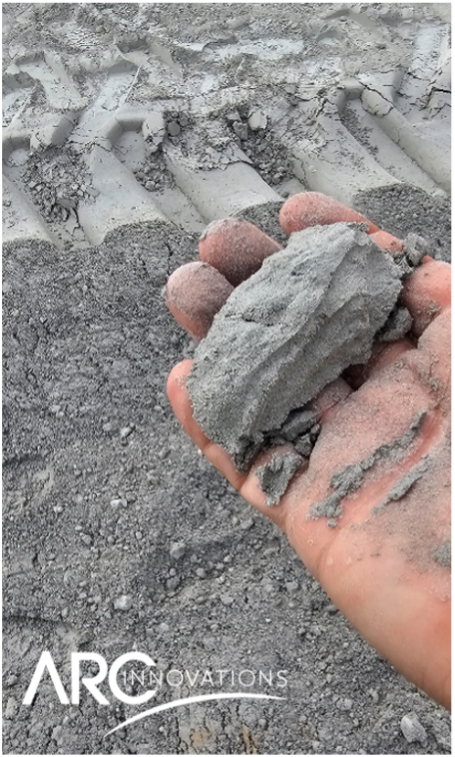
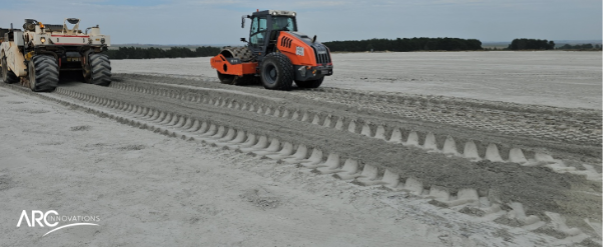
ARC Innovations transforms on-site legacy ash into a predictable, specification-grade construction resource through moisture-controlled binder activation and disciplined process control.
The result is stabilised material delivering reliable strength development, low permeability and negligible shrinkage, suitable for structural pavement and containment applications.



From Liability to Engineered Resource
Legacy ash deposits are widely regarded as disposal liabilities. ARC’s methodology repositions them as locally available construction inputs.
Rather than relying on exotic chemistry, the system is built on controlled processing:
- Grading and ash conditioning
- Binder addition and calibrated moisture adjustment
- Homogenisation
- Controlled placement
- Compaction to specified density
- Trimming and curing
The emphasis is process discipline, not complexity.
Engineering Performance
Relative to untreated ash, stabilised material demonstrates:
- Substantial increases in compressive strength and stiffness
- Improved load distribution capacity
- Enhanced resistance to deformation and rutting
- Negligible volumetric shrinkage under drying
- Significantly reduced permeability
Compared with conventional mechanical compaction alone, binder-activated ash exhibits greater structural reliability and lower sensitivity to moisture variation.
When benchmarked against imported quarried aggregates, the system provides comparable functional performance for base, subbase and working platform applications, while offering lower permeability when configured for liner systems.
The material is therefore suitable for:
- Road base and subbase layers
- Working platforms
- Hardstands
- Engineered fill
- Low-permeability liner systems (when specifically formulated)
Quality Assurance Framework
Performance consistency is achieved through:
- Moisture-density control (field compaction verification)
- Binder dosage validation
- Laboratory strength testing
- Permeability assessment where required
The system behaves as an engineered material, not uncontrolled fill.
Commercial and Operational Advantage
The principal commercial advantages are:
- Lower construction cost compared with imported aggregates
- Reduced haulage and quarry dependency
- Lower embodied transport energy
- Conversion of an on-site disposal liability into a reliable material stream
For power stations and heavy-industry sites with significant legacy ash reserves, this approach provides both environmental risk mitigation and infrastructure value creation
Implementation Pathway
Deployment requires only modest adaptation of conventional construction practice.
A compact pilot programme aligns:
- Local ash chemistry
- Binder formulation
- Moisture conditioning
- Compaction protocol
This ensures the production pathway is optimised before scale-up.
Interested in our cutting-edge solutions?
Connect with us to explore how our solutions can elevate your next project.